Stop saying "I'll try": the one-sentence plan backed by 94 tests
Across 94 tests, if-then plans helped people reach goals. Write a time, a place, a small action, and a response to the obstacle you expect.
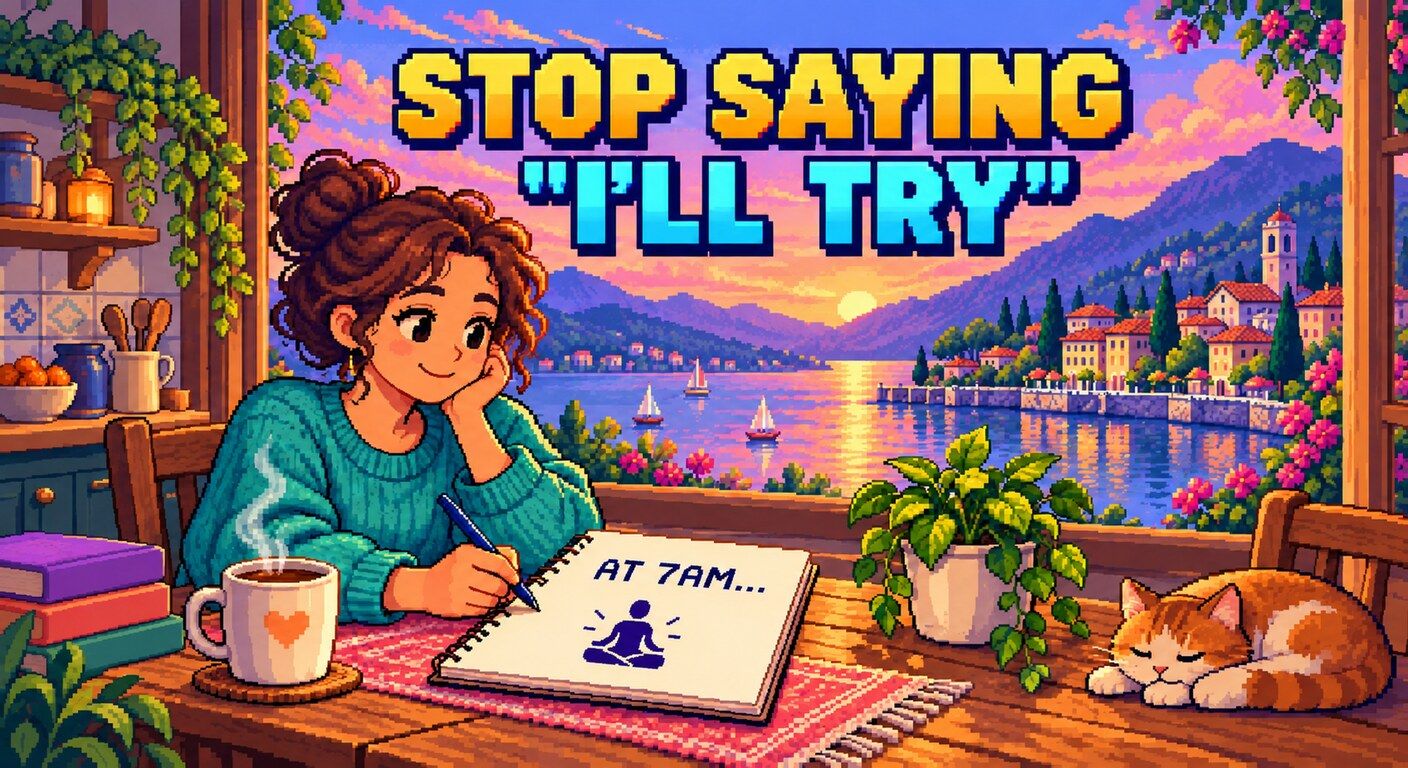
“I’ll try to meditate tomorrow” leaves the moment open. Try writing: “At 7am, at the kitchen table, I’ll meditate.” You can read that sentence and tell when the action begins, where you will be, and what you intend to do.
That is the idea behind this episode. Take a goal you keep meaning to act on and give it a place in your day. Then decide what you will do if the usual plan gets interrupted.
A sentence tested across goals
Gollwitzer and Sheeran pooled 94 independent tests of implementation intentions: if-then plans that specify when and how to act. They found a medium-to-large effect on reaching goals.
The finding supports making a concrete plan. It does not guarantee that every sentence you write will produce the result you want. Give yourself a plan you can carry out, with an action small enough to begin and a response to the difficulty you expect.
Use the four rules from the video to write your own version. You can start with a clock time and place, then add an if-then sentence for an obstacle.
1. Pick a time
Choose a time you can point to in your actual day. “At 7am” is more specific than “in the morning.” Open your calendar or think through tomorrow before choosing the moment.
Write that time into the sentence. For example: “At 7am, I will meditate for two minutes.” If that moment does not fit your day, choose one that does. You are making a decision you intend to follow, so use your real schedule rather than the schedule you wish you had.
2. Pick a place
Choose somewhere you already are, such as the kitchen table. Add it to the plan: “At 7am, at the kitchen table, I will meditate for two minutes.” Read the sentence and picture where you will sit.
For reading, try naming the chair where you intend to open the book. For stretching, name the place beside your desk. Put what you need there before the planned time. Finish choosing the location now, while you are writing the plan.
3. Plan the obstacle
Name something that might interfere. If running late is the difficulty you expect, write: “If I’m late, I’ll meditate for one minute.” Give that situation a response you can recognise and use.
Keep the backup concrete. “Try harder if things go wrong” still leaves you choosing the action later. “If I’m late, I’ll do one minute” tells you what to do. Read both sentences together and check that the backup fits the same habit you are trying to practise.
4. Keep the action tiny
Try two minutes to start. Choose a modest action you are willing to put in tomorrow’s plan. If you want to read, you could choose one page. If you want to write, choose a line.
Be clear about what counts as doing it. Let the small action be a complete attempt, even if you sometimes continue. Write the size alongside the time and place so you do not have to decide how much is enough when the moment arrives.
Write yours tonight
Choose one goal and turn it into a sentence with a time, a place, and an action. Add your obstacle and response underneath. Read the plan once more: can you tell exactly what you will do tomorrow? Prepare what you need for that attempt.
Related reading: The Simple Sentence That Guarantees You’ll Follow Through.
Sources
- Gollwitzer, P. M., & Sheeran, P. (2006). Implementation Intentions and Goal Achievement: A Meta-Analysis of Effects and Processes. Advances in Experimental Social Psychology, 38, 69–119.

Make it a habit with Habit Pixel
Color a pixel for every check-in and watch your consistency grow. Free on iPhone, iPad and Android.


Scan to downloadOpens the App Store or Google Play