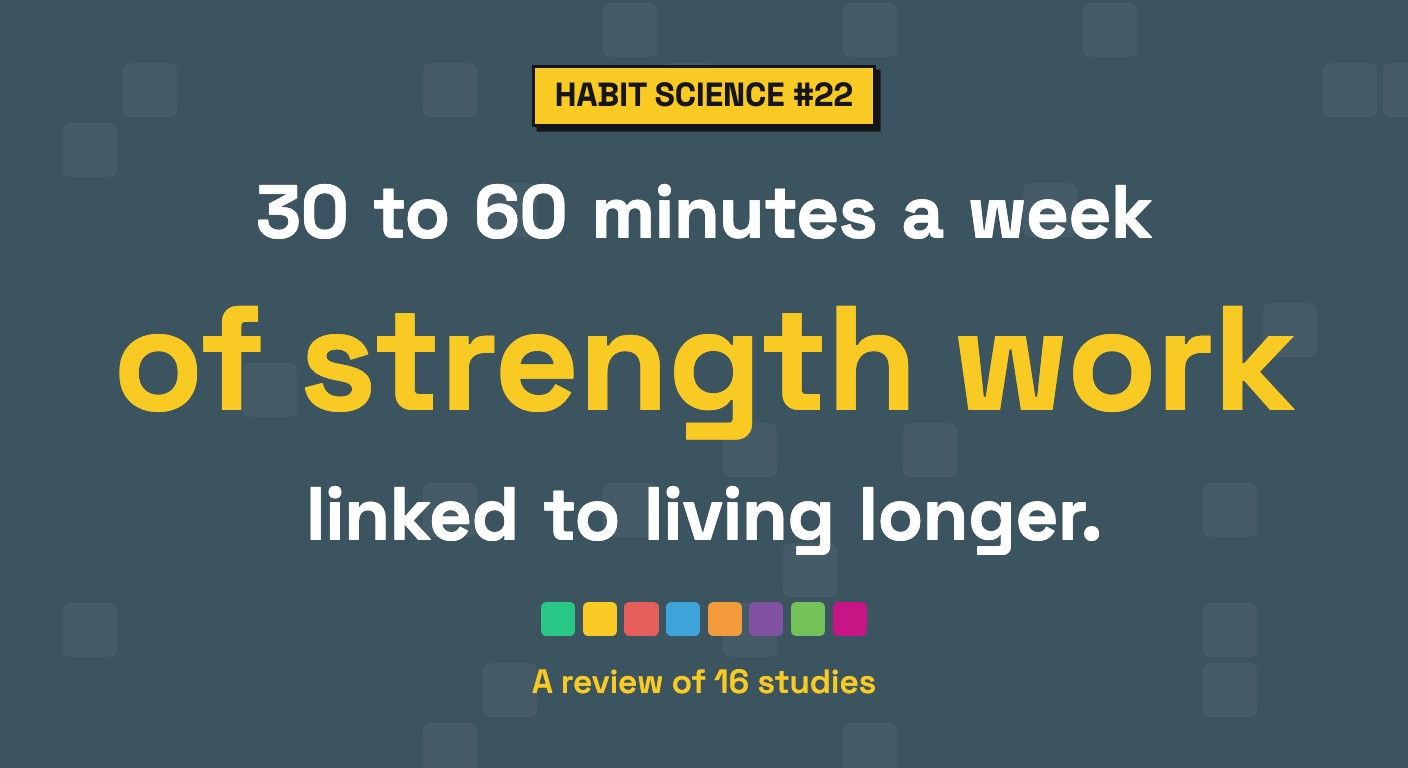
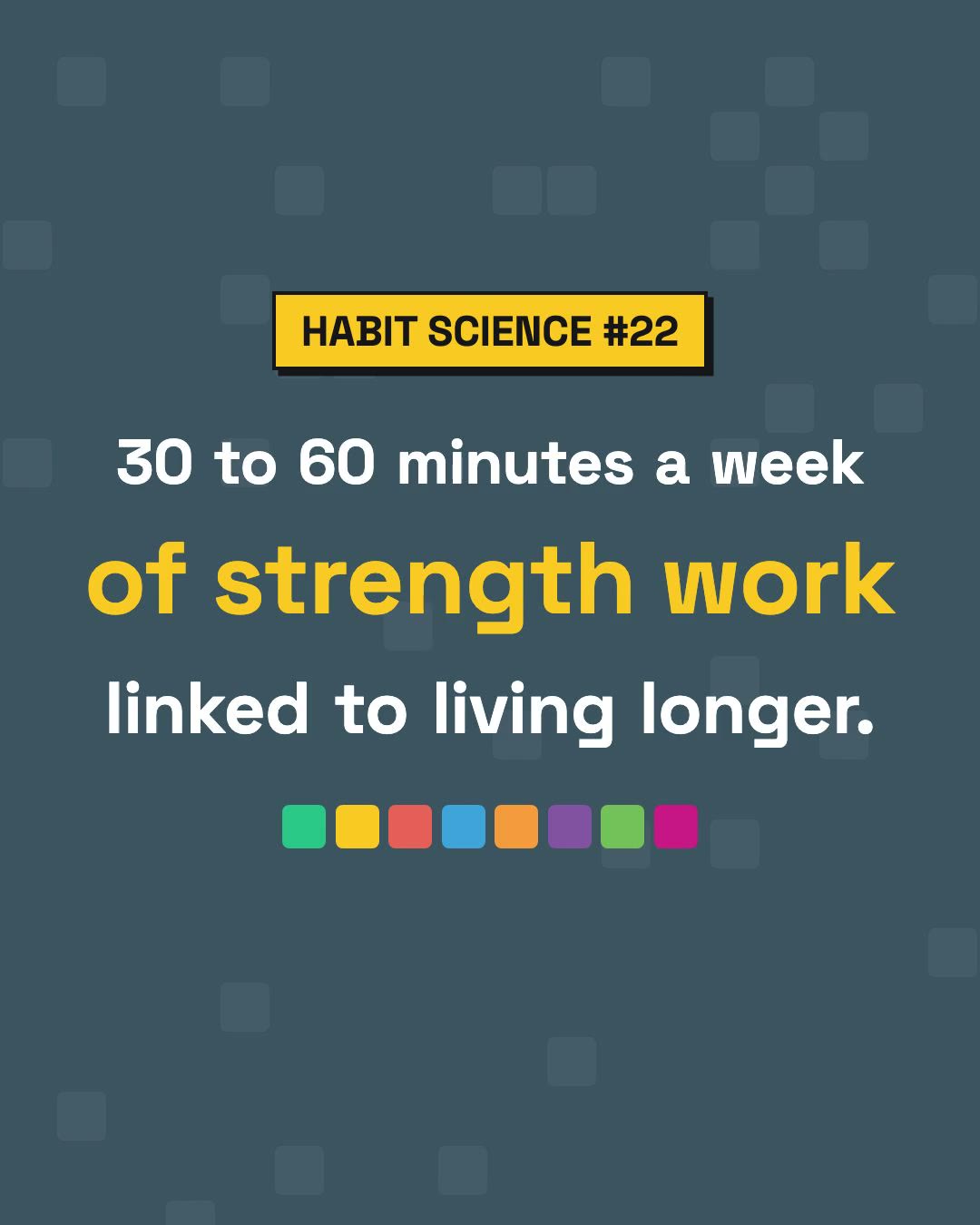
30 to 60 minutes of strength training a week is linked to living longer
A review of 16 studies links a modest amount of strength training with a lower risk of death. Here is what it found, where it stops, and how to fit two short sessions into your week.
Strength training can sound like a big commitment: a gym membership, a programme, an hour you do not have. The research suggests the amount linked to the best results is smaller than most people expect.
A 2022 review found that people who did a modest amount of muscle-strengthening had a lower risk of dying during the studies. The evidence is observational and rated as very low certainty, so treat it as a reason to start small rather than a promise.
What the studies found
Momma and colleagues pooled 16 prospective cohort studies of adults without severe health conditions. These studies follow people over time and record who develops disease or dies. The review looked at strength exercise such as resistance training, weight training and callisthenics (bodyweight exercise), and aimed to measure its link with health separate from aerobic activity.
Compared with no muscle-strengthening, doing some was linked to a 15% lower risk of death from any cause, a 17% lower risk of cardiovascular disease and a 12% lower risk of cancer.
The amount mattered less than you might think. The curves were J-shaped: the largest reduction, roughly 10 to 20%, came at about 30 to 60 minutes a week. For all-cause mortality the lowest risk sat near 40 minutes a week. The risk estimates stayed below the no-exercise level up to about 130 to 140 minutes a week, but the authors say the effect of doing more than that is unclear, and that a higher volume may call for caution.
A second review, by Shailendra and colleagues, pooled 10 studies and found a similar picture. Any resistance training was linked to a 15% lower risk of death from any cause. In a smaller analysis of four studies, the lowest risk was near 60 minutes a week, and the reductions diminished at higher volumes.
Now the limits. These are observational studies, so they show a link, not proof. People who lift may differ from people who do not in ways that are hard to measure. Most studies relied on self-reported exercise, most were from the United States, and Momma and colleagues rated the certainty of the evidence for these outcomes as very low. Even so, for death from any cause every study pointed in the same direction.
Here are the four rules from the video.
1. Two short sessions
The review notes that guidelines suggest muscle-strengthening on at least two days a week, and the authors say that looks reasonable given their results. Thirty to sixty minutes a week works out at roughly 15 to 30 minutes per session.
Choose two days and put them in your calendar. If a session slips, a shorter one still counts towards the week.
2. Bodyweight counts
You do not need a gym. The studies included callisthenics as well as weights. Push-ups, squats and lunges are easy to do at home with no equipment.
Start with a version you can do with good form, even if that means push-ups against a counter. Add a few repetitions as it gets easier.
3. Stack it on a cue
A session with no trigger is easy to postpone. Attach yours to something that already happens: right after your morning coffee, or when you get home from work.
Write it as one sentence, such as “After I finish my coffee, I do two rounds of squats and push-ups.” Then try it tomorrow.
4. More is not always better
The best results in the review were around 30 to 60 minutes a week, and the extra benefit beyond roughly 130 to 140 minutes was unclear. That does not mean longer sessions are harmful, and many people train more for good reasons such as strength, mobility or enjoyment. It means you can treat an hour a week as a solid target rather than a minimum you must beat.
If you have an injury, a heart condition or any doubt, check with a doctor before you start.
Plan your first week
Pick two days, one cue and three exercises. Do the first session tomorrow, however short, and tick it off. Two modest sessions a week is a plan you can keep.
Related reading: Pick the workout you enjoy, not the “best” one.
Sources
-
Momma, H., Kawakami, R., Honda, T., & Sawada, S. S. (2022). Muscle-strengthening activities are associated with lower risk and mortality in major non-communicable diseases: A systematic review and meta-analysis of cohort studies. British Journal of Sports Medicine, 56(13), 755–763.
-
Shailendra, P., Baldock, K. L., Li, L. S. K., Bennie, J. A., & Boyle, T. (2022). Resistance training and mortality risk: A systematic review and meta-analysis. American Journal of Preventive Medicine, 63(2), 277–285.

Make it a habit with Habit Pixel
Color a pixel for every check-in and watch your consistency grow. Free on iPhone, iPad and Android.


Scan to downloadOpens the App Store or Google Play