Stop picturing success. Picture the obstacle
Turn a picture of success into a plan for the obstacle. Try wish, outcome, obstacle, and an if-then response, with the research in perspective.
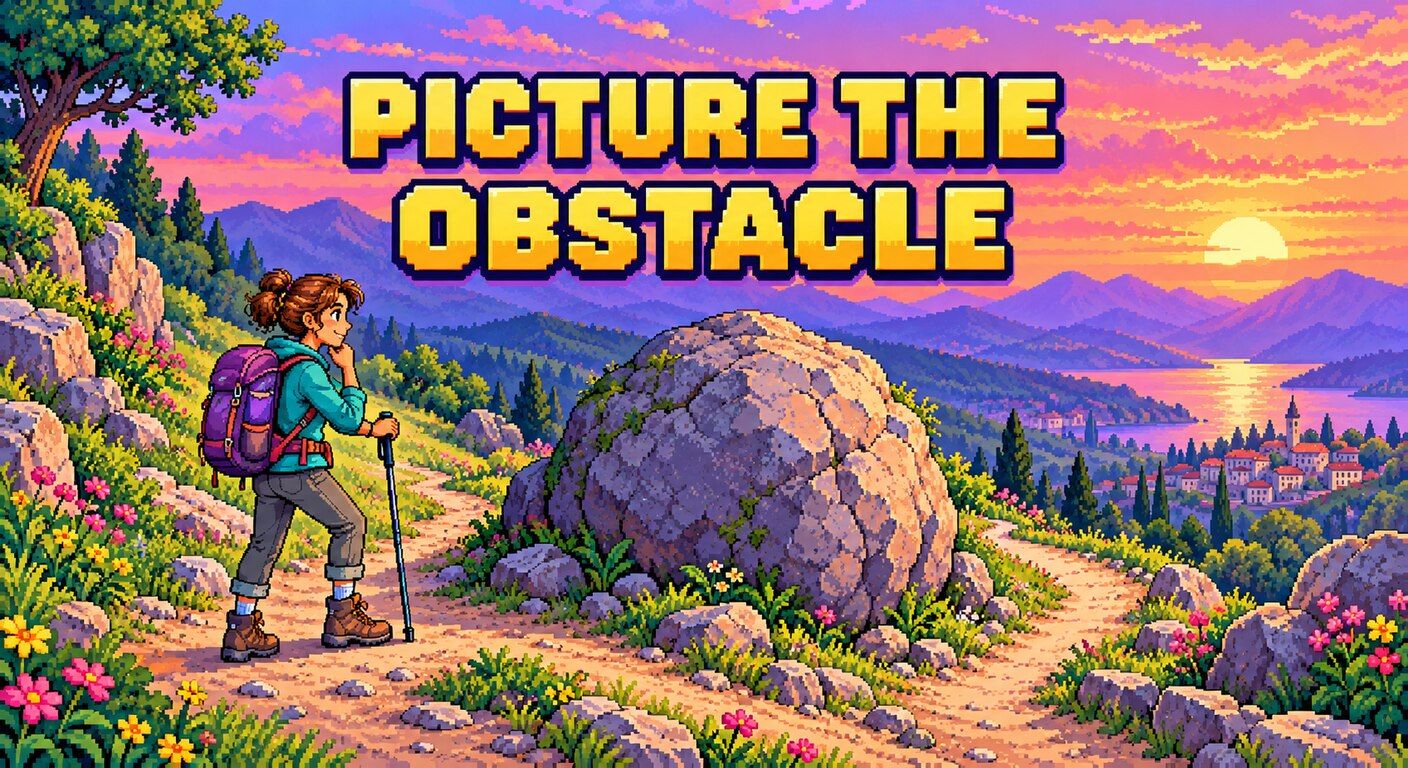
Picture the habit you want to build. Now picture the thing in you that keeps getting in the way. Finish by deciding what you will do when that obstacle appears.
This episode takes you through four steps: wish, outcome, obstacle, and plan. You still name the result you care about. Then you bring the difficult part into the picture and write a response you can use in your actual day.
Add the difficult part to the picture
In Oettingen and Mayer’s research, graduates with rosier career fantasies sent fewer applications and received fewer job offers two years later. That association does not mean every hopeful thought is harmful.
In a four-month trial with 256 women, those taught to picture their wish, identify an internal obstacle, and make an if-then plan exercised about 96 minutes a week. The information-only group exercised about 49 minutes a week.
A review of 21 studies found a more modest benefit overall. Keep that broader result alongside the striking trial result. Use the method as something to practise, with a plan for your own obstacle.
1. Name your wish
Choose something you want to do: “Bike to work.” Make the wish specific enough that you can imagine attempting it. You could choose a reading, walking, or writing habit instead, if that is the action you want to work on.
Write the wish at the top of a page. Read it and check that it names an action you can plan around. If you wrote “be healthier,” choose the particular action you want to try. Keep that action in view as you work through the next steps.
2. Picture the best outcome
Name the result you care about. For biking to work, the video’s example is “getting into better shape.” Write why this wish matters to you and take a moment to picture that outcome.
Use your own reason. For reading, you might want to finish a book you have been looking forward to. For writing, you might want a draft you can return to. Choose the outcome that makes you want to attempt the action, then continue to the obstacle.
3. Identify your biggest obstacle
Look for something in you that could block the action. In the biking example, the obstacle is getting up too late. Choose the difficulty you actually expect, rather than writing a general list of everything that could go wrong.
Try describing it in plain language: “I stay in bed too long,” or “I put on the news before I leave.” Pick the obstacle you want to plan for now. Be specific enough that you could recognise it happening tomorrow morning.
4. Write an if-then response
Connect the obstacle to something you will do: “If I get up late, I skip the news.” Read the sentence and check that it gives you an action at the moment you named.
For another habit, you could try a small backup: “If I feel too tired to stretch, I will do one minute.” Choose a response you are willing to carry out. Write it beneath the obstacle and keep the full plan where you can read it before your next attempt.
Do the four steps tonight
Write your wish, the outcome you want, the obstacle you expect, and your response. Check that the final sentence tells you what to do when the obstacle appears. Prepare for that version of the day as you plan your next attempt.
Related reading: The Resilient Habit: How to Plan for Obstacles Before They Happen.
Sources
-
Oettingen, G., & Mayer, D. (2002). The motivating function of thinking about the future: Expectations versus fantasies. Journal of Personality and Social Psychology, 83(5), 1198–1212.
-
Stadler, G., Oettingen, G., & Gollwitzer, P. M. (2009). Physical activity in women: Effects of a self-regulation intervention. American Journal of Preventive Medicine, 36(1), 29–34.
-
Wang, G., Wang, Y., & Gai, X. (2021). A Meta-Analysis of the Effects of Mental Contrasting With Implementation Intentions on Goal Attainment. Frontiers in Psychology, 12, 565202.

Make it a habit with Habit Pixel
Color a pixel for every check-in and watch your consistency grow. Free on iPhone, iPad and Android.


Scan to downloadOpens the App Store or Google Play