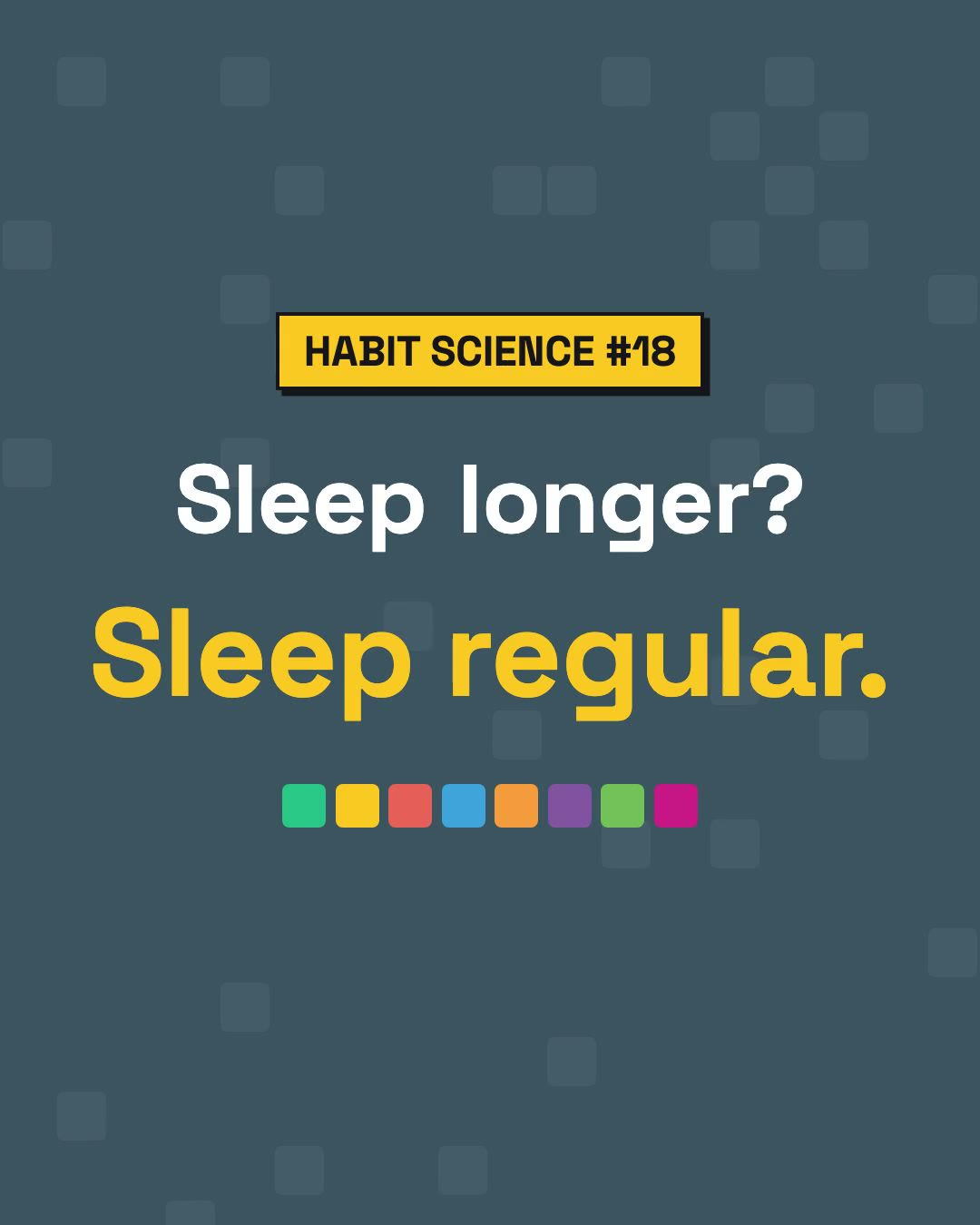
Sleep regularity may matter more than how long you sleep
In a large study, regular sleepers had a lower risk of death than irregular ones, and regularity predicted it better than sleep length. Four ways to keep your sleep steady.

Most sleep advice is about hours. Get seven, get eight, stop cutting it short. Hours matter, but there is another question that gets far less attention: do you go to bed and get up at roughly the same times each day?
Two studies suggest that consistency deserves a place next to length. Neither proves cause and effect, but both point the same way, and a steadier schedule is one of the cheapest changes you can make.
What the studies found
Windred and colleagues used movement trackers to measure the sleep of 60,977 UK Biobank participants, then followed them for an average of about six years. They scored each person on how closely one day’s sleep and wake times matched the next.
After adjusting for age, sex, ethnicity, and a range of social, lifestyle and health factors, the most regular fifth had about a 30% lower risk of death than the least regular fifth. Regularity predicted mortality better than sleep duration did, and once regularity was in the model, adding sleep length made no significant difference.
The authors are clear that this is a correlation. Irregular sleep could be a cause of poorer health, a sign of it, or both.
A much smaller study by Phillips and colleagues followed 61 Harvard undergraduates for 30 days. Irregular sleepers slept just as long as regular ones, a little over seven hours a day on average. But their melatonin rhythm started about two and a half hours later, they got less light during the day, and their grades were lower. Again, the researchers could not say which caused which.
So the honest summary is this: regular sleep travels with better outcomes, even when total sleep is the same. Here are four ways to practise it.
1. Pick a wake-up time and keep it
Choose one wake-up time you can hold on workdays and days off. Weekends are where most schedules drift, so aim to stay within about an hour of your usual time.
Waking is easier to control than falling asleep. You can set an alarm for the morning, but you cannot order yourself to sleep at 10:30. A fixed wake-up time gives the rest of your schedule something to line up with.
2. Anchor a wind-down routine
Tie the start of your evening wind-down to something you already do every night. “After I brush my teeth, the lights go low and the phone goes on the charger” is a plan you can follow without thinking.
The routine gives your bedtime a cue, which makes it less likely to slide whenever the evening gets busy. Keep it short enough to do on a tired night.
3. Get morning light
In the student study, irregular sleepers had weaker daily light patterns, and a model suggested light explained most of the delay in their body clocks. Daylight in the morning helps keep that clock anchored.
Try stepping outside within the first hour of your day, even for a few minutes. Have your coffee by a window, or walk part of the way to work.
4. Skip the big lie-in
A long Saturday lie-in feels like catching up, but it is also irregular sleep. Sleeping until noon after a week of 7am alarms is the kind of day-to-day swing these studies measured.
If you are short on sleep, an earlier bedtime keeps your schedule steadier than a much later morning. Keep your wake-up time close to normal and let the extra rest come at the start of the night.
Start with one time
Choose your wake-up time tonight and write it down. Set the alarm for every day of the week, not just workdays, and pick the routine that will start your wind-down. Give it a couple of weeks before judging how it feels.
Related reading: Your Day’s Anchor: The Power of a Consistent Wake-Up Time.
Sources
-
Windred, D. P., Burns, A. C., Lane, J. M., Saxena, R., Rutter, M. K., Cain, S. W., & Phillips, A. J. K. (2024). Sleep regularity is a stronger predictor of mortality risk than sleep duration: A prospective cohort study. Sleep, 47(1), zsad253.
-
Phillips, A. J. K., Clerx, W. M., O’Brien, C. S., Sano, A., Barger, L. K., Picard, R. W., Lockley, S. W., Klerman, E. B., & Czeisler, C. A. (2017). Irregular sleep/wake patterns are associated with poorer academic performance and delayed circadian and sleep/wake timing. Scientific Reports, 7(1), 3216.

Make it a habit with Habit Pixel
Color a pixel for every check-in and watch your consistency grow. Free on iPhone, iPad and Android.


Scan to downloadOpens the App Store or Google Play