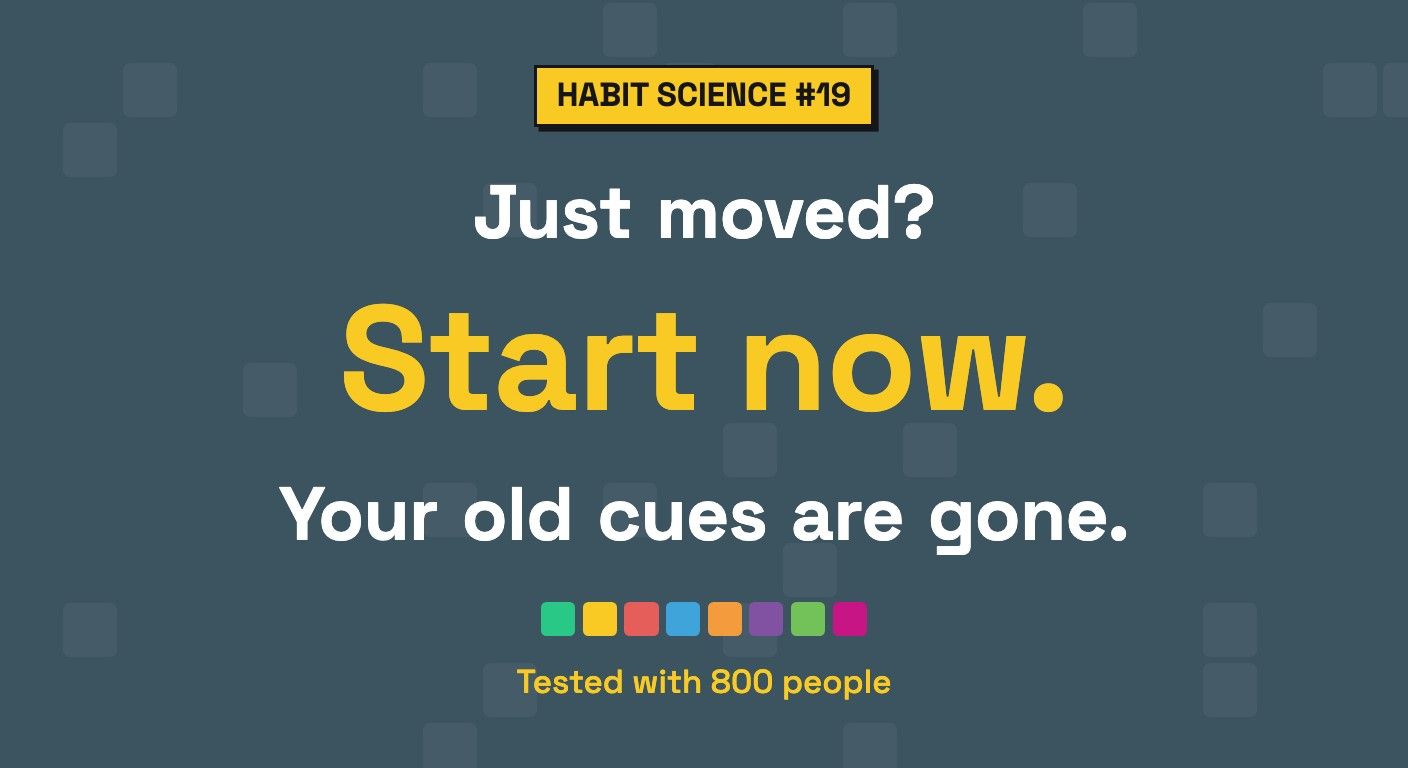
Just moved? Now is the time to start a new habit
A move or a new job breaks the cues behind old habits. Research suggests the first few months are a good time to set up the routines you want.
Moving house feels like chaos for a while. The kettle is in a box, the route to work is new, and nothing happens at quite the usual time. That disruption has a useful side. Many of the cues that kept your old habits running have gone, and for a short time you get to choose what replaces them.
This episode looks at the research behind that idea, sometimes called the habit discontinuity hypothesis, and how to use the weeks after a big change.
What the studies found
Wendy Wood and colleagues followed 115 students transferring to a new university, asking about exercise, reading the newspaper and watching TV a month before and a month after the move. Habits tended to survive only when part of the setting stayed the same. Students with strong exercise habits kept them up when they carried on exercising in the same kind of place, such as at home or a gym, but not when the location changed. In some cases, once the old setting was gone, what students intended to do started to guide what they actually did.
Bas Verplanken and Deborah Roy then tested the idea in a field experiment with 800 people in Peterborough, England. Half had recently moved house. Some received a programme of tips and a personal conversation about greener living; others received nothing. Eight weeks later, the programme had made more difference to people who had moved recently, and the effect seemed to be limited to roughly the first three months after the move.
That study deserves some care. The behaviours were self-reported, about a third of people did not return the follow-up questionnaire, and the authors describe the boost from moving as small, more a proof of concept than a large effect. The three-month window came from a tentative follow-up analysis. Still, it points the same way as the student study: a change of setting loosens old routines.
This is different from the fresh start effect we covered in an earlier episode. A Monday or a birthday changes how you feel about starting. A move changes the cues themselves.
1. Decide your routines early
Use the first weeks in a new place to choose how your days will run. Where will you walk? When will you read? What happens straight after you get home? If you leave these questions open, the old patterns tend to fill the gap.
Pick one habit and give it a time and a place in the new routine. “After I unlock the front door, I change into walking shoes” is easier to repeat than a general wish to move more.
2. Set up the new place for the habit
You are arranging the furniture anyway, so arrange it for what you want to do. Put your shoes by the door, a book beside the bed, a water bottle on the desk. Each object can act as a cue in a setting that has no cues yet.
Think about the first few seconds of the habit and make those as easy as possible. The fewer steps between the cue and the action, the more likely you are to start.
3. Drop the old cue you don’t want
A move is also a chance to leave something behind. If evening TV used to run late, try leaving the TV out of the bedroom. If you snacked on the sofa, put the snacks somewhere out of sight in the new kitchen.
It is often easier not to set a cue up than to remove it later, once it has become part of the room.
4. Any big change counts
The research here is mostly about moving house and changing university, but the same logic applies to other changes that rearrange your days: a new job, a new school, a new term. When your schedule and surroundings shift, ask which habits you want the new version to include.
If the window has already passed, you have not missed your chance. You can still change a cue on purpose, for example by moving where you work or what you see first in the morning.
Use the change you’re in
If something in your life has recently shifted, choose one habit now. Give it a place in the new routine, set up the cue, and start while the old patterns are still loose.
Related reading: Why do we start on Mondays? The fresh start effect explained.
Sources
-
Wood, W., Tam, L., & Guerrero Witt, M. (2005). Changing circumstances, disrupting habits. Journal of Personality and Social Psychology, 88(6), 918–933.
-
Verplanken, B., & Roy, D. (2016). Empowering interventions to promote sustainable lifestyles: Testing the habit discontinuity hypothesis in a field experiment. Journal of Environmental Psychology, 45, 127–134.

Make it a habit with Habit Pixel
Color a pixel for every check-in and watch your consistency grow. Free on iPhone, iPad and Android.


Scan to downloadOpens the App Store or Google Play