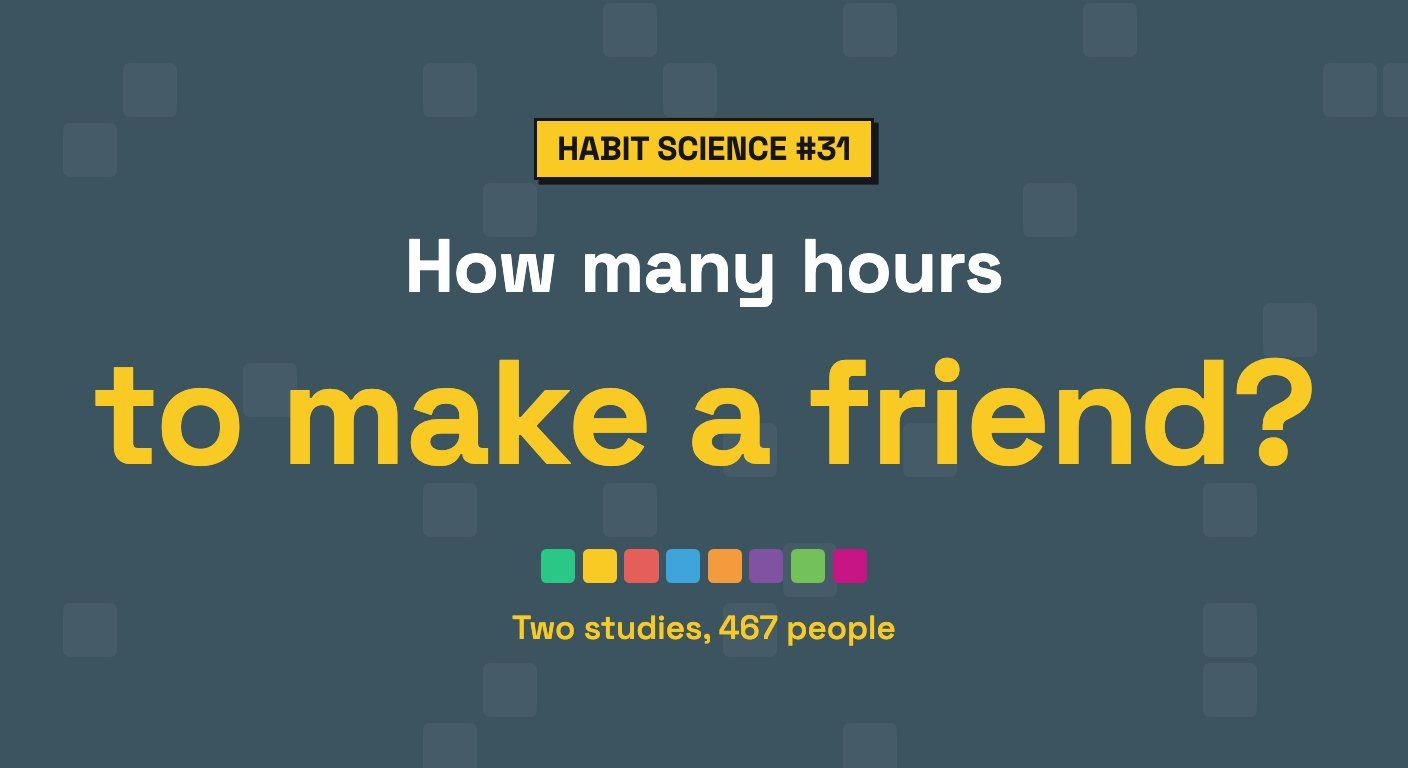
How many hours does it take to make a friend? About 50 for a casual one
Two studies estimated how many hours together it takes to move from acquaintance to friend. Here is what they found, what they cannot tell you, and how to fit those hours into a normal week.
Friendships rarely arrive on a schedule. You meet someone, get on well, and then the hours either add up or they do not. A University of Kansas study put numbers on that, and they are bigger than most of us would guess: tens of hours for a casual friend, a couple of hundred for a close one.
Those numbers are rough estimates from surveys, so treat them as a guide to how much time friendship needs, not a countdown.

What the studies found
Jeffrey Hall ran two studies. In the first, 355 adults in the US who had moved at least 50 miles in the past six months named someone they had met since moving, rated how close they were, and estimated the hours they had spent together. In the second, 112 first-year university students named two people they had met since arriving and answered similar questions three times, at about 3, 6 and 9 weeks into the semester.
For each step up in closeness, Hall looked for the number of hours at which the closer label became more likely than not. Among the students, that point came at about 43 hours for a casual friend rather than an acquaintance, 57 hours for a friend rather than a casual friend, and 119 hours for a good or best friend. Among the adults, who were looking back over about three months, the same points were about 94, 164 and 219 hours. Hall notes the adult figures are probably inflated, and combining the two studies he reached rough ranges: 40 to 60 hours to form a casual friendship, 80 to 100 to become a friend, and more than 200 to become a good friend. The university’s press release rounded these to about 50, 90 and 200 hours, which is where the headline numbers come from.
What the numbers cannot tell you
The hours were self-reported, and the adult study looked backwards, so it only included friendships that lasted. Both studies are observational: people may get closer by spending time together, but they may also spend more time with people they already like. The students were mostly women, around 18, and many met in the same dormitories, which makes time together far easier than it is for most adults. Hall also points out that friendship takes two people, so you cannot decide it alone.
There is a wider reason to care. A 2010 meta-analysis of 148 studies, with 308,849 participants in total, found that people with stronger social relationships had a 50% higher likelihood of survival (odds ratio 1.50). That too is observational, the authors say causality is not easily established, and it measured social ties in general, not friendship specifically. It is a reason to take the question seriously, not proof that friends add years.
1. Put friends on the calendar
Hours only accumulate if they happen. Two hours a week comes to roughly 50 hours in six months, so a weekly slot beats “we should catch up soon”. The students reached their totals within weeks partly because they lived beside each other; most adults need a standing plan to get the same effect.
2. Repeat the same plan
A standing walk, a weekly class or a regular game night saves you renegotiating every time, and the paper counts cumulative hours with the same person. In the adult study, time spent together at work or school was linked to less closeness, while hanging out, watching TV or gaming was linked to more.
3. Talk about real things
In the student study, catching up on what has happened since you last met, talking through your day, serious conversations where both of you take part, playful talk and showing affection were grouped together. More of that predicted growing closeness between surveys, over and above the hours themselves. Small talk, such as current events, pets, sports and TV, predicted a drop in closeness between weeks 6 and 9. The overall share of time spent talking was not linked to closeness, so what you talk about seems to count. Again, this is a link: small talk may simply be what fading friendships look like.
4. Say yes to the second invite
You cannot tell in advance which acquaintance will become a friend, so accept the next plan, then suggest one yourself. Hall’s own advice: “You can’t make people spend time with you, but you can invite them.” If you only see someone at work, he suggests switching the context, for example going to lunch.
Start with one standing plan
You do not need to find 50 hours this week. Pick one person and one repeatable plan, schedule it, and tick it off when it happens.
Related reading: Work out with someone a bit better than you.
Sources
-
Hall, J. A. (2019). How many hours does it take to make a friend? Journal of Social and Personal Relationships, 36(4), 1278-1296.
-
Holt-Lunstad, J., Smith, T. B., & Layton, J. B. (2010). Social relationships and mortality risk: A meta-analytic review. PLOS Medicine, 7(7), e1000316.
-
Hellman, R. (2018). Study reveals how many hours it takes to make a friend. KU News Service.

Make it a habit with Habit Pixel
Color a pixel for every check-in and watch your consistency grow. Free on iPhone, iPad and Android.


Scan to downloadOpens the App Store or Google Play