How much time in nature do you need each week?
A survey of nearly 20,000 adults in England linked at least 120 minutes a week in nature with better health and wellbeing. Here is how to fit two hours in, however you split it.
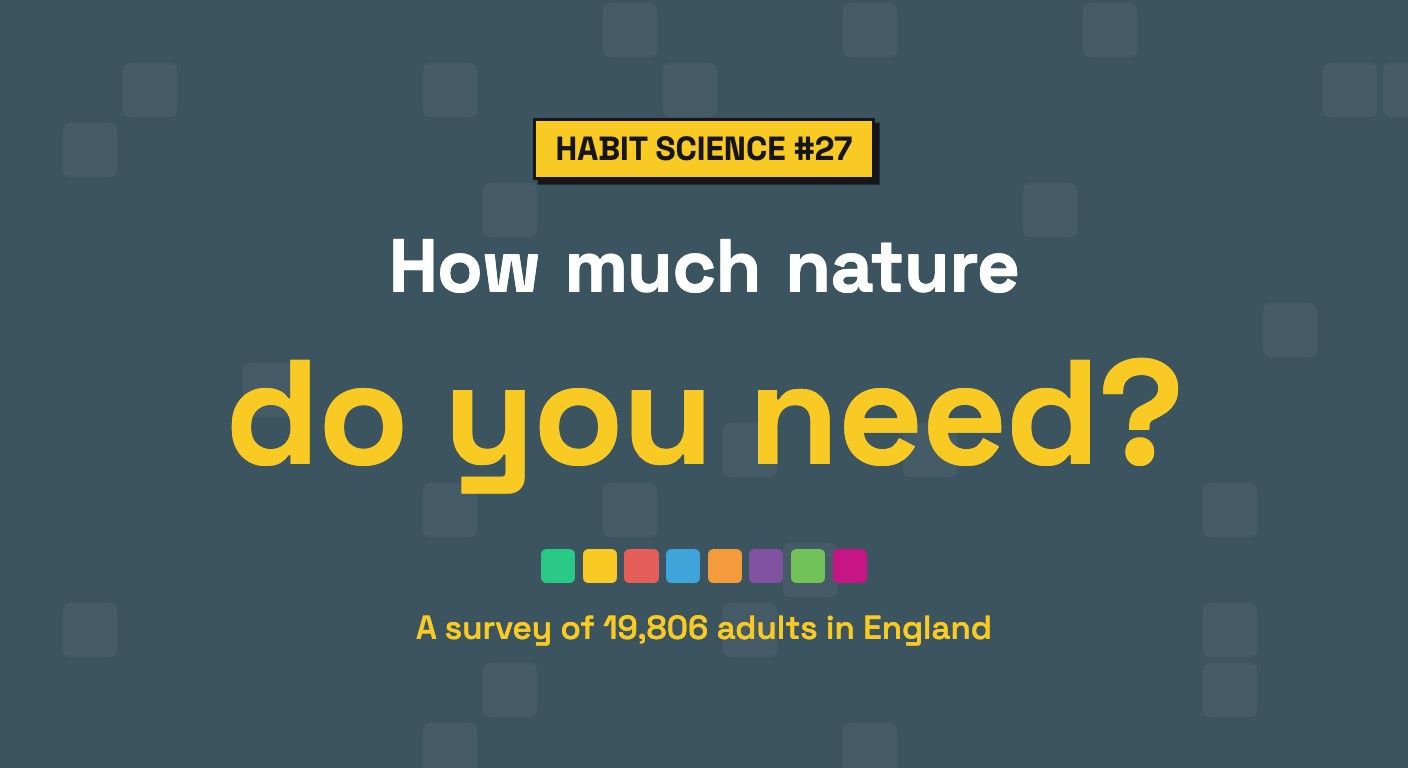
If most of your week happens at a desk, in a car or on a sofa, “get more nature” can feel vague. How much counts? Where? A large survey in England put a number on it, and it is smaller than you might expect: about two hours a week.
That number comes from a survey, not an experiment, so treat it as a sensible target to try rather than a prescription.

What the survey found
White and colleagues analysed answers from 19,806 adults in England, taken from a national survey that is part of the UK’s official statistics. People were asked about time they had spent outdoors in the past week: in “open spaces in and around towns and cities, including parks, canals and nature areas”, on the coast and beaches, or in the countryside. Routine shopping trips and time in your own garden did not count. They also rated their general health and their life satisfaction.
Compared with people who reported no time in nature, those with at least 120 minutes in the week were more likely to report good health and high wellbeing. For 120 to 179 minutes, the adjusted odds ratios were 1.59 for health and 1.23 for wellbeing, after accounting for things like age, occupation, local deprivation, neighbourhood greenspace and physical activity. In plain percentages, before any adjusting, about 84.5% of that group rated their health good or very good, against 72.3% of people with no time in nature.
Less than 120 minutes showed no clear difference from none. The link peaked at around 200 to 300 minutes a week, with no further gain beyond that. It held for men and women, for people over and under 65, and for people with and without a long-term illness or disability. And it did not matter whether the time came as one long visit or several shorter ones.
The authors are candid about the limits. The data are observational and cross-sectional, so they cannot rule out that healthier, happier people simply spend more time outdoors. Time in nature explained only a small share of the differences in health and wellbeing, and weekly minutes were estimated from the length of one randomly chosen visit. They call 120 minutes a tentative threshold and say it is too early for firm guidelines.
A hint for shorter visits
A much smaller study looked at single visits. Hunter and colleagues asked 36 adults in Ann Arbor, Michigan, to spend at least 10 minutes in an outdoor place that gave them a sense of contact with nature, at least three times a week for eight weeks, and took saliva samples before and after. Levels of the stress hormone cortisol fell by more than the normal drop across the day, and the drop per minute spent was greatest at 20 to 30 minutes, with smaller gains after that.
It is a small, self-selected group (92% women, who chose their own times and places), so read it as an early hint rather than a rule.
1. Aim for about 2 hours a week
Two hours is roughly 17 minutes a day, or a couple of longer outings. Think of it as a weekly total rather than a daily streak, so a rainy Tuesday does not wreck anything. If you are well short of it, any step up is a fair start; the survey just did not see a clear difference until about the two-hour mark.
2. Split it any way you like
Two long walks or six short ones: in this survey, the pattern looked the same. The authors point out that people choose what fits their lives, and telling a weekend walker to switch to short visits, or the reverse, may be misguided. Pick the shape you will actually repeat.
3. Let a park count
The survey counted parks, canals and other green spaces in and around towns and cities, as well as beaches and countryside. A city park on your lunch break or a path along a canal fits that description. Your own garden was left out of the measure, so if you want to count it, treat that as your own rule, not the study’s.
4. Plan a slot
Two hours does not appear on its own. Give it a place in the week, such as “Saturday morning, the park”, and put it in your calendar like any other plan. If you already walk, route it through a park, or lengthen it by ten minutes. Pairing it with something you already do makes it easier to start.
Start with one slot
You do not have to find two hours this week. Choose one outing you can repeat, schedule it, and tick it off when it happens. Add a second slot when the first feels easy.
Related reading: You don’t need 10,000 steps a day.
Sources
-
White, M. P., Alcock, I., Grellier, J., Wheeler, B. W., Hartig, T., Warber, S. L., Bone, A., Depledge, M. H., & Fleming, L. E. (2019). Spending at least 120 minutes a week in nature is associated with good health and wellbeing. Scientific Reports, 9, 7730.
-
Hunter, M. R., Gillespie, B. W., & Chen, S. Y.-P. (2019). Urban nature experiences reduce stress in the context of daily life based on salivary biomarkers. Frontiers in Psychology, 10, 722.

Make it a habit with Habit Pixel
Color a pixel for every check-in and watch your consistency grow. Free on iPhone, iPad and Android.


Scan to downloadOpens the App Store or Google Play