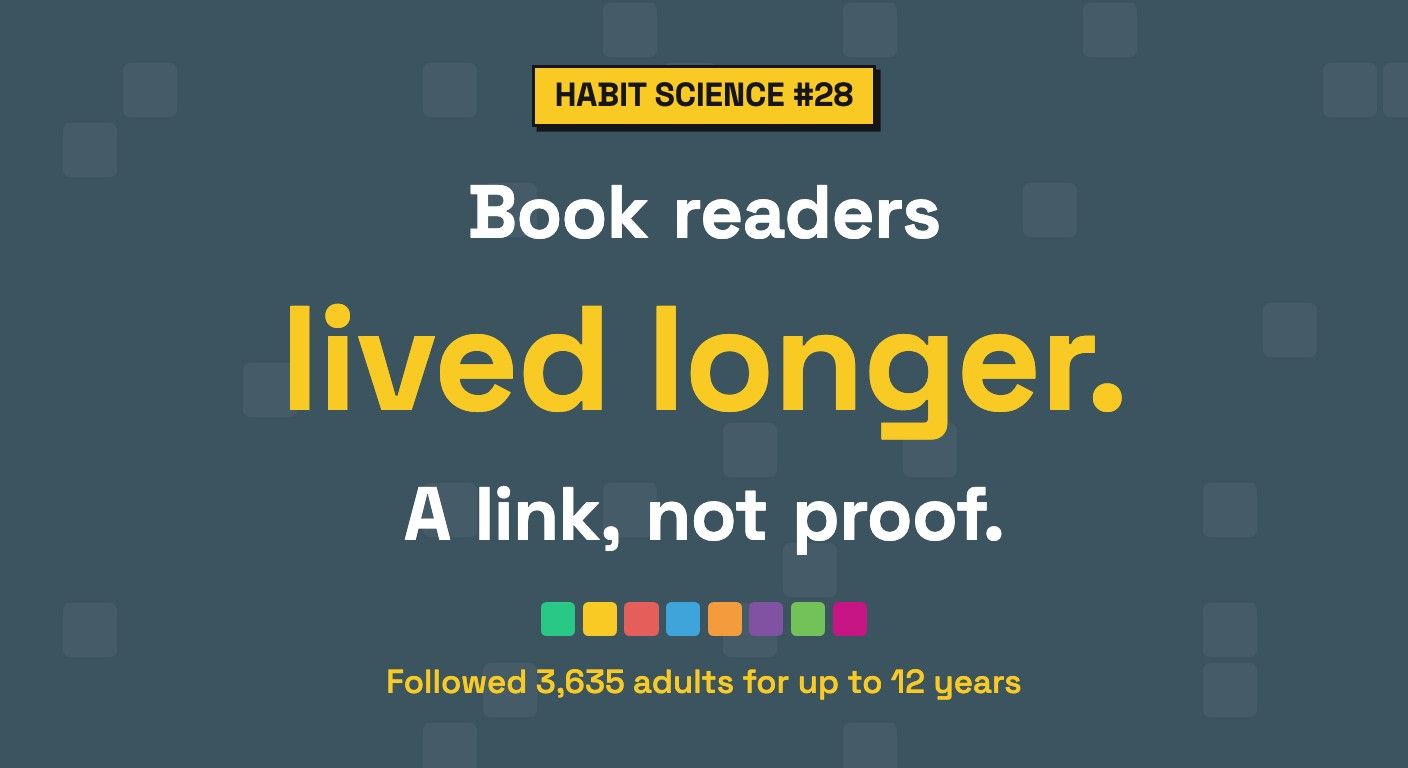
Book readers lived longer in a study of 3,635 adults
Older adults who read books had about a 20% lower risk of death over up to 12 years. It is a link, not proof, but a chapter a day is an easy habit to start.
Most of us would like to read more books and keep not getting to it. A long study of older adults offers one more reason to try: the people who read books lived longer than the people who didn’t.
Before you treat a book as medicine, the catch. This was an observational study, so it shows a link, not a cause. Still, the habit it points to is cheap, pleasant and easy to fit into a day.

What the studies found
Bavishi, Slade and Levy used data from the Health and Retirement Study, a US survey of adults over 50. They looked at 3,635 participants who had been asked how many hours they spent reading books in the previous week. Of these, 59% read some books and 41% read none. The researchers followed everyone for up to 12 years, about 9.5 years on average, and 27% of the group died in that time.
After adjusting for age, sex, race, education, wealth, marital status, job status, chronic conditions, depression and self-rated health, book readers had a 20% lower risk of dying during follow-up than non-readers. Reading more than about 3.5 hours a week, roughly 30 minutes a day, went with the lowest risk, though lighter reading was linked to a lower risk too. Reading newspapers and magazines showed a smaller link.
The gap looks bigger or smaller depending on how it is counted. Without adjustment, book readers took 23 months longer than non-readers to reach the point where 20% of their group had died. After adjustment, that shrank to about 4 months. The authors also found that scores on a cognition test appeared to help explain the link, and a test of the reverse direction found no sign that thinking skills simply led people to read more.
That does not rule out other explanations. People who read books may differ from those who don’t in ways no questionnaire captures, and the study cannot say that reading itself added the time.
A second, smaller study points the same way on the brain. Wilson and colleagues followed 294 older adults for an average of 5.8 years of memory testing, then examined their brains after death. People who reported more mentally stimulating activity through life, including reading books, had slower cognitive decline late in life, even after accounting for the damage found at autopsy. It was a selected group and part of the activity was recalled from memory, so treat it as supporting evidence only.
Here are the four rules from the video.
1. Read a chapter a day
Thirty minutes is about 3.5 hours a week, and it is the amount the authors called “a chapter a day”. A chapter is a handy unit because it has a natural stopping point.
Lighter reading was linked to a lower risk as well, so if thirty minutes is too much, begin with ten and let the chapter grow.
2. Pick books, not headlines
Book reading showed a bigger link than newspapers and magazines in this study. A book holds your attention on one thread for longer than a feed of short items.
You don’t have to give up the news. Just make sure some of your reading time goes to something with chapters.
3. Keep the book in sight
A book in your bag is easy to forget. A book on your pillow, on the arm of the sofa or next to the kettle gets noticed. Put it where you sit or sleep, and move your phone to charge across the room.
Leave it open at your page if you can. The less effort it takes to start, the more often you will.
4. Pair it with a cue
Link the chapter to something you already do every day. “After I brush my teeth, I read a chapter.” “When I sit down on the train, I open my book.”
A cue turns “I should read more” into a specific moment. Check the habit off each day so you can see the streak grow.
Start tonight
Choose one book, put it where you will see it, and decide which daily moment gets the first chapter. Read it tonight and mark it done.
Related reading: Habit stacking: build new habits on top of old ones.
Sources
-
Bavishi, A., Slade, M. D., & Levy, B. R. (2016). A chapter a day: Association of book reading with longevity. Social Science & Medicine, 164, 44–48.
-
Wilson, R. S., Boyle, P. A., Yu, L., Barnes, L. L., Schneider, J. A., & Bennett, D. A. (2013). Life-span cognitive activity, neuropathologic burden, and cognitive aging. Neurology, 81(4), 314–321.

Make it a habit with Habit Pixel
Color a pixel for every check-in and watch your consistency grow. Free on iPhone, iPad and Android.


Scan to downloadOpens the App Store or Google Play